It’s perfectly ok to use a new tool to do your work faster, more efficiently, and with greater precision if these improvements are justified by the cost of the tool. But if that tool is a coal-fired, water hoarding, ophan crushing, billionaire-owned kleptobot, your results need to be better than pure gold to be worth the true cost of using it.
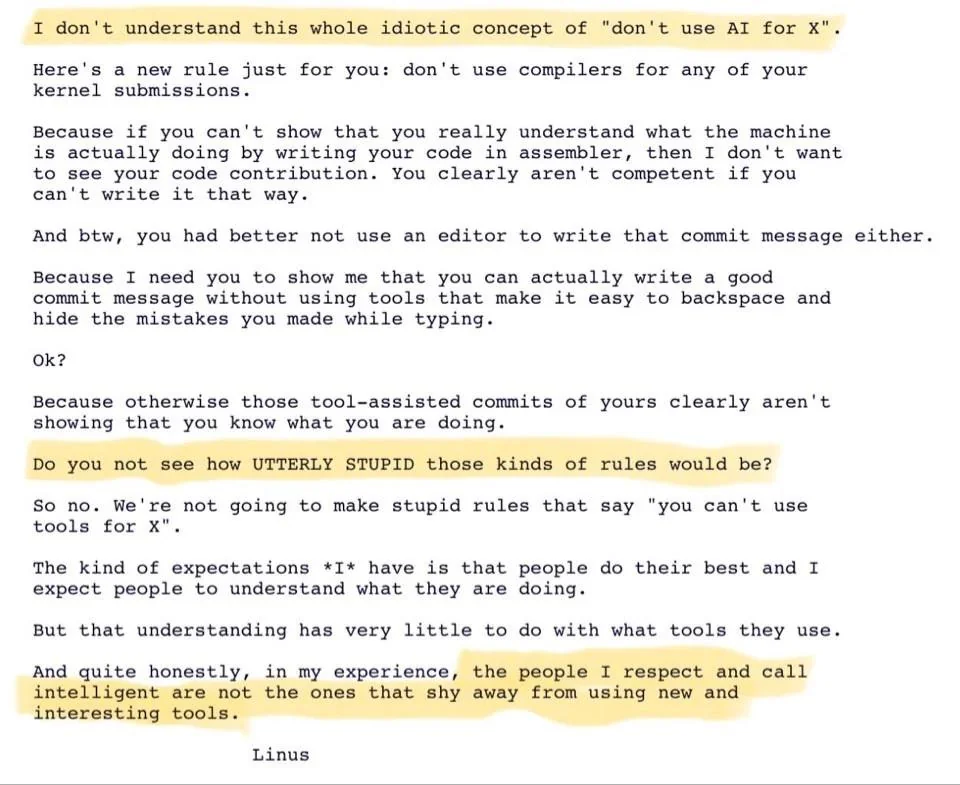
I don’t care about Linus, Stallman’s opinion is the interesting one.
I’ve thought since the beginning of all of this that the biggest mistake was calling all of these LLMs and other tools that they smashed together “AI”. It’s misleading and ruins the reputation of all of the tools. If someone had made a coding tool that ONLY did what “AI” does with coding, no one would give a shit. But now because an LLM spelled “Strawberry” with too many “r’s” well that means it’s all slop and it’s all shit.
As for the people throwing shade for ethics, EVERYONE breaks their ethics for consumption and EVERYONE has their justifications. I’m not saying that environmental issues aren’t important, they very much are, but giving others shit for their choices when half of your clothing and your phone partly relies on slave labor and stripping of the environment weakens your attempt. It’s easy to sit on a high horse and judge others for their use of AI. It’s much more difficult to understand the nuances of why they do. Just like you would want someone else to try to understand the nuances of why your shoes cost $150 and the 9 year old who made them was only paid 2 cents.
The point that I’m trying to make here, is that you can complain about AI without shitting on others.
Linus become like one of the boomers excited by some dumb ai slop on Facebook
But worse he doesn’t care about how unethical is the present ai
I lost respect for this guy
“the kind of expectations i have is that people do their best and i expect people to understand what they are doing.”
my immediate response to some idiot thinking i accuse him of cheating because i voiced concerns over his methodologies: “look, if you want to drink mercury while writing code and dont see any problems with that, fine. go ahead. waste away your health. but at least have the decency of sitting under the venting hood and stop making it everyone elses problem.”
When the topic is AI, the quality of some of these Lemmy threads drops down to the level of YouTube comments.

I got banned from the Fuck AI community for saying Linus isn’t stupid. Not that he’s right on AI, just that he’s not stupid.
Indeed, the atmosphere is toxic.
We’re on a site where people happily discuss their arr stack or transpiring the PS5 system, but bemoan AI is killing artists and coding.
There are real ethical issues, job impacts, environmental issues, property rights issues (real and intellectual), privacy, a stack of cards economy etc.
But there is also utility, and frankly the genie is out of the bottle. For better or worse.
Catching kernel bugs in Linux with AI should be seen as a good because they’re not being exploited offensively by private actors. AI review that catches the most annoying 80% of errors or issues saves human time, while not contributing slop to the kernel.
There is a lot to discuss if you show up in good faith.
Also, Linus is an asshole. Why would anyone be surprised he reacted like an asshole? His point on his expectations is actually clear and sensible to me. He probably could have said just that, but he’s an asshole, and acting how you would expect after a bunch of people are yelling at him.
Nuance is a hard concept to get in most Lemmy comment threads. It’s obvious it’s just a tool that uses an insane amount of resources that can do some good in certain applications. The problem stems from it being abused for evil and stupid things.
Can AI be used to help flag cancerous growths in x rays and help save lives? Absolutely! Can it also be used to track every human being on the planet for surveillance purposes while its proponents build massive biome-destroying data centers to act as the infrastructure? It sure can!
All that said, I still don’t feel confident about rolling in AI code to open source projects when bots aren’t accountable to their contributions. They should require a huge amount of oversight which I doubt is happening at the moment.
I want to expand on your first thought and just say that in my experience the internet as a whole is not a great place for nuanced takes, and I’ve noticed that becoming mirrored in reality over the last decade. Perhaps its been happening for longer.
There’s so much going on, and so many actors trying to influence the masses. I don’t blame anyone for having different conclusions to my own, there’s an almost untrackable amount of sources to draw information (and disinformation) from. I just hope we can get to a point together where we can (again?) discuss nuance without ceding to emotion.
Agreed.
On AI contributed code I’m always confused, if I put MY name on it and push it I am stating it meets my standards. If I allow a Claude contributed commit into my code, I am stating Claude passed my standards.
If someone is contributing and it’s not up to standards, why is it getting merged? If it’s a maintainer and they’re merging crap with review or standards then you couldn’t have actually trusted them pre-LLMs.
Ever since the first iteration of GitHub Copilot it was always your responsibility to make sure contributions to your project were correct. The beauty of open source is that when a project jumps off a cliff you can fork it or make your own.
Partially what is good about Linus is historically Linux has said no to crap, and the Linux team expend considerable effort to remove crap they realized was crap too late.
From my layperson understanding, the true program is not the lines of code, it’s the model that lives in the programmer’s brain. The code is just an extension of that.
If it needs debugging, it is the mental model that helps. If you need to add a feature, same thing. If a few years go by and no one remembers how the code works, rebuilding that mental model is the first step in making progress.
I suspect that it used to be that if someone contributed good code to the kernel project, it meant that they had a sufficient mental model. But with AI, it can seem like they do.
Maybe if you’re Linus your understanding of the kernel is so strong it would take years to atrophy, if at all. I don’t know. But developers in general?
Too many times in my work life, people have told me one thing, but it turns out that AI invented that and they didn’t really know what they were talking about. On things that I’m an expert in, I can catch it. But if I’m not an expert, I don’t realize the mistake until a consequence occurs.
Allowing AI is basically making it so the maintainers have to be complete experts in everything they accept. Maybe that was already the case, but that is my layperson understanding of it.
This is correct. And yes, we expect everyone that contributes to have this understanding. If you don’t have it, welcome to ask. Misunderstandings that happen despite your effort will be caught by the steward.
This comment disguising itself as nuanced by saying the word nuanced a bunch is really nuanced.
Just don’t engage with any community that starts with “fuck” if you have any kind of nuance for the subject matter.
It’s not a great time. If you don’t get banned, you’ll get dogpiled with angry and idiotic comments anyway, by people who have decided their own facts already.
All the fuckX communities are toxic for the same reason.
No nuance. No complexity. Binary.
The world is not black & white it’s shades of grey.
I got banned from saying not all that is called ai is bad by giving video game npcs from the last decades as an example.
I thought it was just llms that they where against but nope. I imagine Alan Turing spinning in his grave.
Vague criticisms, fallacious reasoning, highly emotive language, little response to attempts at discussion (though some might engage in disingenuous discussions of shifting goalposts here and there to discourage particularly vocal engagees from future participation). So I’d say that Linus is just the latest convenient scapegoat in an Anti-AI ‘trend’ that will have little impact on the rate of AI adoption in the long run.
Sucks that I waited until now to try to form a measured opinion on AI because now all the discussions on the internet are hot garbage.
Measured perspectives are hard to come by. A Marxist Perspective On AI
There’s nothing Marxist in that article. Only fallacies from rich white man ranting about people pushing back against fascism.
People say AI to mean LLM first because main stream western, fascist, media pushed the term by inviting exclusively non-expert and CEOs to talk about the subject. People are pushing back against a product that is mean to make workers dull and replace them by
stealing their works even by capitalist standards-> exploiting their works, appropriating it to themselves without any compensation nor permission.The article tried to paint the discussion as anti-llm would be anti technology, which is not Marxist in any way and not relevant. Weirdly enough fascist guy like the one on this article don’t talk about cryptocurrency as something we should chill for. Isn’t it a tool too?
Current LLM chill is the opposite of dialectical materialism: what is the concrete analysis here? LLM outputed nothing of value for years despite the hundred of billions invested. Worst it actually participate to global warming, bourgeoisie attempt to mass control, getting rid of workers and inflating computer costs. So the real consequences for people are losses only.
And for what? To get to have unskilled rich white people who can afford the awfully hight price of LLM to boats about “I made this” while it is actually made from steal and empoverish people and enriching tech lord’s.
So no, thanks, and trying to paint fallacies to Marxism isn’t going to help either.
EDIT: replace the “stealing” argument as pointed out -> https://lemmy.ml/post/54102413/28384201 , this can be confusing with the anti-piracy propaganda vocabulary.
stealing
Stealing: when you don’t have it anymore afterwards.
Copying: when both have it afterwards
The RIAA’s propaganda campaign was sadly very successful.
You’re right, I said “steal” as it was the most common word, the right one was “exploiting”. Fixing it.
Actually let me analyze again your comment here: I thought you were right at first but thinking about it not really.
First let me address : I didn’t know about RIAA, this kind of paternalistic way of addressing people is not good in any way. We aren’t all USA-centric (like you?).
Then about the “steal” argument:
- it is a vocabulary used for century by Marxist organizations about the value taken by the bourgeoisie from the proletariat work.
- the argument of “copying is OK” is missing the point : any FOSS dev/organization I know would gladly give their work to you, individual. But not to big tech to commercialize it and make extreme amount of money, as well as steering conversation towards fascism in the process. While also having an amazingly big impact on the environment.
- “both have it afterwards” is also a fallacy : any work done on computer can be seen like this : if your an accountant and you boss copy your accounting sheets and do not pay you, it is not stealing? You both have the file, for you it won’t make you any money, he will. Big tech taking FOSS code for their profit is not piracy as of individual accessing cultural product they cannot afford in the first place. And if you make profit from piracy this is a whole other discussion I would gladly here your thoughts about it.
Downloading this comment is not authorized.
Then about the “steal” argument:
You wouldn’t download an argument, would you? Or would you? What, you’re reading this in your browser without authorization from me?? FBI, open up!!!
are you trolling?
I checked your history and you seems to genuinely interact but you’re sentence makes no real argument (more like a joke).
But maybe you haven’t read the rest of the conversation so here some points:
- You can and are encourage to download and use free software. Same with comments.
- You are not allowed to monetized free software (hence the GPL v2 vs v3 debate). To be honest also with my comments.
- The term stealing could indeed be confused with the modern usage of fascists who want to fight against piracy but it was used for a good century by communist to talk about capitalists stealing surplus value made by workers.
Private property is theft. “Intellectual property” is a form of private property. It exclusively benefits the bourgeois.
Regarding your third bullet point: Try your example again, but this time the boss doesn’t copy the file. It’s still labor theft. The copying is irrelevant.
Are you saying I am right then? I feel you think of something but it is not clearly getting to me here.
it's labor theft-> hence the termstealI was usingcopying is irrelevant-> so I was right? the labor theft of big tech in order to sell LLM is wrong on many level and we should fight against it.
Do you at least see that, to me, what you just said is validating my points?
Also if anyone else (not to you @m532): “AI” (in reality chatbot or generative AI) should be made by the people for the people, and FOSS ideology (can we say Librism in English?) have always, and still mostly is, against the closed-source (close dataset to be precise here) nature of current big-tech AI. This was already a problem 8 years ago when the space started to get filled with “scientific” paper that didn’t disclose code/data (sometime just code but still insufficient) hence couldn’t be reproduce while sometimes having wild claims. We shouldn’t give so much credit, attention, money to those fascists in charge of selling as much LLM as possible, whatever human, economic and environment costs.
Bad news, @yogthos@lemmy.ml, you’re not a Marxist, and your analysis is the opposite of dialectical materialism.
I’ll never recover from this. 🤣
was that supposed to be an argument against my explanation?
Obviously it wasn’t, or I would have made an argument.
Yes please do not make any argument and post memes with some interesting comments
When the topic is AI, the quality of some of these Lemmy threads drops down to the level of YouTube c omments.
Really helps.
We have our share of radicals
I would like to reiterate that posting on main as an admin is obnoxious since we can’t block you.
Consider using an alt to post unless performing official instance actions.
I would like to reiterate that posting on main as an admin is obnoxious since we can’t block you.
If you can’t block me, that’s an issue with your Lemmy client, because the default web client isn’t stopping you.
You’re wrong: https://github.com/LemmyNet/lemmy/issues/6706
Oh, thanks, duly noted.

Button is right there man
the button is there, but clicking it does not do anything, can’t do it via the profile or searchbar either
What are you using? Web or some app?
just the basic lemmy.ml website.
i personally don’t care about posting opinions on an admin account, but they seem to be right. suspect it’s to do with living on the same instance.
blocked.
Cory Doctorow’s “Reverse Centaurs Guide to Life After AI” has a short section that pertains to this. He talks about how someone like Linus essentially doesn’t have a boss and has untold resources for whatever “AI” “tools” he finds useful.
He isn’t ever forced to use the wrong tool for the job or use a tool that simply doesn’t do what his boss thinks it does. He doesn’t have to worry about getting fired or his coworkers getting fired because his boss was sold a story about reducing labor costs with this cool new “tool”. He simply uses what’s useful to him with the probably millions of dollars of compute made available to him by the tech giants.
95% of people don’t have that luxury. They have a boss itching to get rid of them or 10x their workload with the help of the “tool” that Linus is so happily and defiantly praising on behalf of the monopolists.
I don’t see how this means he’s wrong though, if people are hating AI as a proxy for hating their abusive relationship with their employer, that doesn’t seem like a strong argument that everyone who isn’t in that situation must also hate AI.
It doesn’t mean he’s wrong! it means he’s out of touch and doing the propaganda work of capital for free much like many other self-employed/business owning/petit-borgeois people who think they’re on the side of capital.
It also means that his praise for and indeed positive experience with this “tool” is largely irrelevant to the broader social/economic discourse surrounding so called AI.
Blind hatred for AI as a technology is inherantly reactionary, but that doesn’t mean that the implementation of the technology today isn’t problematic in many ways.
Yeah I notice he doesn’t address the costs, economic and environmental, of LLM proliferation. Way to ignore a large part of the argument while calling anyone opposed to your position stupid.
I hope he gets to eat those words one day, but I doubt he would ever admit he was wrong.
@TwiddleTwaddle@lemmy.blahaj.zone
I hope you were shamed by this reply, on the use of commas in a subordinate clause.
Hahaha my writing style is runon and compound complex sentences without commas.
Oh my god a reasonable take for once. Thank you for putting into words why his heel-turn has bothered me so much
It’s funny, the c/fuckai mod that banned me a while back said the same thing. Iirc it was “How very reasonable of you. Banned”
One should look at China when they’re concerned about the USA approach.
Then the picture would be significantly changed if the cost of running useful LLMs goes down to what it costs to acquire a reasonable computer to work on the Linux kernel, no? That is if we could run useful LLMs for kernel programming on our kernel programming computers, and we own those LLMs. In such a world, capital would have no stronger leverage over us than it already does by selling us the computers we need to program. Does this argument make sense?
It also means that his praise for and indeed positive experience with this “tool” is largely irrelevant to the broader social/economic discourse surrounding so called AI.
Yeah, but tbf all of the statements he’s making about it are in the context of organizing linux development and the most effective way to carry that out, and just happen to be public and so end up being widely republished and incorporated into discussions with a broader topic than that.
Yeah, I don’t think Linus should be policing his speech at this level or for this cause. Educate the workers please, Linus is doing plenty.
Shush! They are not supposed to know that the AI–Anti-Ai fight is fabricated bullshit with both sides being equally stupid (like people arguing based on ideological zeal always are…). And that it’s just a show so that the majority is occupied with watching the mud fight so they don’t think about the actual problem.
What’s the point of this argument though? Sure it’s real for every profession and every tool but what’s the agentic choice we ought to pursue here? Whine against AI or actually lead society with policy? As “ban llm” is not a valid policy that would ever work so the only viable path is regulation and growing of culture where AI is used for good, no?
Embrace AI, work towards open weight/free software and protect worker rights. Society wins at the bleeding edge not at conservstism.
The answer is certainly not to embrace “AI” in it’s current forms or allow for big tech monopolists to continue their wasteful and destructive infrastructure buildout. The oligarchy isn’t going to regulate itself to worker self-determination either. Nothing short of the death of capitalism will do.
Nothing short of the death of capitalism will do
Ok, let me know how that goes. While you whine online and have no impact on reality we will embrace “AI” and drain billionaire funds for distillation, open weights and building free software.
You genuinely don’t see the effective differences of thse two strategies? Actually doing something vs having your finger crossed some magical boogeyman called “capitalism” will collapse?
I think there’s a broader question here from an evolutionary perspective. Humans are fundamentally tool users, and technology has been central to our development as a species. It’s possible that this evolutionary niche we’ve occupied will eventually reach its limits and contribute to our own downfall, but I’m not convinced AI is uniquely responsible. It’s part of a much longer trajectory of technological progress.
We’ve evolved to solve problems and use tools to make our lives easier. That doesn’t mean technological progress is inevitable, but these tendencies, combined with competition, make it difficult to imagine us ever really stopping. Even if we stopped today, who’s to say another generation of humans 10,000 years from now wouldn’t continue down the same path?
I don’t think this is exclusively about capitalism. Capitalism certainly incentivizes growth and reducing labor costs, but competition, greed, and the pursuit of technological advantages have existed under other economic systems too. That doesn’t diminish the legitimate concerns about how AI is being used against workers.
I also wonder whether our short lifespans make us particularly bad at considering the long-term consequences of our innovations. Who is going to sacrifice the opportunities of their own generation to prevent a possible catastrophe centuries from now, especially when there’s no guarantee it would stop technological progress?
I have a degree in psychology and particularly enjoyed evolutionary psychology, so I think it’s worth asking whether the deeper problem is our own nature, and whether our capacity for collective restraint can keep pace with our ability to innovate.
I know this raises more questions than it answers, but we’ve faced civilization-changing technologies before, from the printing press and electricity to nuclear weapons. AI won’t be the last. Perhaps the more important question is how we learn to manage these transformations when our tendency to create them seems so deeply rooted in who we are.
Which is great as an explanation for why so many people recoil at Linus saying ‘the tool is mostly fine’ - but it’s zero percent of an argument against that claim. A famous cold-war engineer celebrating the slide rule while new hires are being spanked with them is not really encountering a productive conversation about their utility.
Lemmy is the strangest place to find people hesitant to conclude ‘the actual problem here is capitalism.’
This argument is conflating the bad boss with the misattribution of the tool. You could do that for any tool throughout history. But I still fail to see how you go from “bad boss is bad because they make us misattribute tool” to “good boss is bad because he’s not wallowing with me about how bad boss is bad”.
As anyone who has known about him for more than a couple of years knows, Linus has a pretty solid track record of calling out stupidity. It’s just virtually always stupidity that affects the kernel. If he had to stop and tell bosses at other companies how to operate, Linux never would have made it out of the 90s.
So he lacks empathy is what you are saying.
I guess I have that luxury, but I sacrificed hard to get where I’m at.
And, truthfully, way more people could do it if they didn’t feel entitled to the easy way (college > world destroying corp).
Entirely irrelevant to the conversation at hand but okay
I like Linus, but comparing an LLM to a compiler is fucking stupid.
Why?
You can predict with certainty what a compilers output would be. Linus is conflating the fact that most people don’t understand how a compiler converts higher level programming language into machine code with the reality that no one can actually predict and audit what an LLM puts out.
He is saying that you have to understand your contribution, so whatever the LLM spits out, you need to thoroughly review and double-check that it makes sense. So, in particular, he’s not trying to rate these tools, he’s merely saying make sure the contribution is objectively good, then he doesn’t care how you got there.
I got that part and I agree with it.
My issue is him saying don’t use a compiler if you don’t really understand the machine language it creates. This conflates LLM with a compiler as a tool when they are inherently different. This is disingenuous because it is possible to understand and audit what a compiler creates. You cannot audit what an LLM creates in even close to the same way.
But why can you not audit what the LLM creates? You can’t do it for the general case, i.e. prove that for a given prompt it always spits out a valid solution, but you can look at what it actually spit out for your concrete prompt and then you can freely decide, if those code changes are good.
I am of the opinion that a thorough review often takes similarly long to actually writing it yourself, and there’s a high chance that you miss architectural aspects, if you don’t investigate yourself.
But yeah, again, I think you’re taking the comparison too literal.
He is just saying that LLMs are a tool. You need to know how to use your tool and produce objectively good results. Then he does not care what tool you use to get there.Can you elaborate on the last sentence a bit from a technical perspective? I’m not using code myself to the extent that I could really judge between LLM-generated code being good or just-works. I can just imagine compiler output being strictly deterministic, while LLM-code, due to the way a LLM works in principle, should be more …unstructured?
I honestly didn’t think you could even audit an LLM. It is possible, but not in the same way you would audit code. It is my understanding, because of the probabilistic nature of how the LLM operates, you can get different results even within the same model. This makes tracing something like logic next to impossible. Why the LLM gave the result is somewhat of a mystery. It is in effect a black box. This may change in the future, but for now LLM suffers from this issue.
Sleeping agent in LLM is a scary topic and the tech itself has mathematically no solution for this: https://arxiv.org/html/2401.05566v2
You cannot, that’s why reproducible builds are hard. Modern compiler are made with compilers (egg/chicken problem) not assembly nor machine code and you always loose some perfect prediction.
Yes LLMs are less predictible than compiler but their output is readable to human, while machine code is very hard (yet not impossible).
Is that a bad things that 99% of devs have forgot how to write code cutting holes in paper? Tools are changing and while a direct comparison between the move from paper to COBOL or assembly to C is not the same as python to LLM generated it’s hard to deny that LLM will change how human write code.
Predicting what a compiler outputs is quiet hard, especially if you enable optimization flags or get near any undefined behavior. But I think you’re right to say that a compiler is more predictable than any LLM. I don’t get the point why you should be unable to audit the output of an LLM? If its used as a tool like described the user should have the knowlage to audit any output
I can run a compiler.
Then I can run it again, and the output will be the same.
I can run a LLM prompt.
Then I can run it again, and the output should be the same. The unpredictability is what makes the tech great - Nobody in decision making actually understands this, but the goal is not for identical outputs. Just like me and you, don’t respond to the same question in the same way every time
Compilers aren’t all that deterministic without effort. Example, both gc and clang if ran with parallelism can produce different results purely off file system lookup differences alone. This means intermediate archive files can be equivalent in content from the perspective of functions built but differ in order. This can easily filter up to the final binary being different. Making compilers bitwise deterministic is a lot more effort than running the same compiler on the same input. This is ignoring things like timestamps and other common sources of non determinism. But I can say the Debian reproducible build project has most of this figured out but compilers are not as deterministic as your comment implies. They can be, but you should really check that your final binary is bit for but the same. If you’ve used any parallelism it likely isn’t.
If we then bring in lto et al it gets worse.
Let’s take just gcc, are you setting -frandom-seed, SOURCE_DATE_EPOCH, -file-prefix-map, are you ensuring the input file list is deterministic? If you’ve used any can’t affirm yes to at least these 4, note these are just the things I can remember, you do not have a deterministic compile chain.
For local LLMs you can set the seed and generate the same output every time.
But I rarely want the output twice? At least in this domain of coding, the entire point is doing it once.
Secondly, I can definitely validate it in most ways that matter. Ironically, by compiling it for example, I make 100% certain the output was well defined code. Type checking, linting, tests, etc. all help ensure I got functionally valid code.
At that point I might not really care if the function name or a variable name is different, just like I don’t care that the compiler did some kind of heuristic optimization or minified the names or something.
In both cases, I have a target functionality, and I need to validate it was reached. The way I got there doesn’t matter (in most cases).
It’s a bit like Docker vs. Nix. Sure, docker isn’t really reproducible perfectly, but it fulfills it’s goal for most people most of the time for a fraction of the time and effort taken.
At that point I might not really care if the function name or a variable name is different
At least clean it up so it’s maintainable, introducing tech debt is a long term impact
You can get the same output from the LLM if you put the appropriate guardrails and context in place. That’s what is happening in the enterprise space.
I was just pointing out Linus was conflating the two to make his point. I don’t agree with this, but everything else he said was fine.
100%, or we’d commit prompts instead of code lol
all the undefined behaviors would like to disagree with you there champ
Can you elaborate?
Compilers are incredibly complex things and the often have undefined behaviors that slip in because the compiler has to interact with the operating system at large, and that means the code actually doesn’t run the same on every platform, or even every version of the same operating system. So, while they are technically deterministic, the reality is that you get surprising and unexpected behaviors in practice.
Also worth nothing that the probability distributions for an LLM are fixed at training time, and that is why the weights are static. When doing inference, models are selecting from a top-k of probable tokens at each autoregressive loop for your typical LLM. When you adjust top-k to 1 or simply set the “temperature” to 0, it will always give you the same result from the same input.
Thanks
The other practical side of this is enforceability.
Lets say Linux banned all use of VSCode in contributions, this second. And any Microsoft tools. No exceptions. And it makes sense, because there is an evil blatantly anti-linux entity behind it… What are people gonna do?
Keep using it anyway, and just not disclose it.
This is why linux doesn’t tell people what tools they can and can’t use. Practically, they can’t police what tools people use, just what they contribute. Just like (to a reasonable degree) they don’t try to police people who contributes to the kernel, but instead judge them by their contributions. Other contributors don’t have to like those tools or contributors, but that is how a project like this must operate.
Much of open-source development relies on the honor system. There is likewise no way to tell, just by examining code, that it was not plagiarized.
Honor that needs to be enforced is not honor. It is something less.
It relies on legality, not honor. E.G. with GPL, or code with a proprietary license. It’s the threat of losing their job, getting sued or whatever that discourages plagarism.
The other practical side of this is enforceability.
There is likewise no way to tell, just by examining code, that it was not plagiarized.
Non-point elements removed to help you focus.
Ah I get your point now. Yes, ultimately both policies would rely on honor.
I’d argue plagiarism is different, though. If a codebase stipulates ‘don’t plagiarize,’ that’s… common morality. Not many contributors are going to argue ‘well, I want to plagiarize.’ They wouldn’t advertise it in any project they contribute to.
Dictating what tooling to use is different. That’s going to fall under ‘personal choice’ for more contributors. And they may feel compelled to hide tool use for that particular project, when they would otherwise show its use publicly in others.
In other words, forbidding tools like, projects runnings be telling contributors to forgo something they’re used to using public. That’s going to trigger more lack-of-disclosure and rule-breaking from devs that otherwise wouldn’t do that.
Strangely idgaf about whether he respects me
I don’t think he thinks about you at all
👍🏻 The vast majority of people don’t.
hes comparing knowing how open concepts work vs using proprietary tech whose purpose is to hook you and then enshittify after you become reliant on it
I guess Linus doesn’t care about the environment or any of the other issues surrounding A.I. I’m not anti-AI just for the sake of being anti-AI. I have a huge problem with AI bcz of it’s environmental impacts, intellectual property violations, job impacts, attempts to replace all employees with AI, the general dumbing down of society and worse off the internet is bcz of AI, the surveillance state being built around it. I could go on, but you get the point. I am a staunch, no AI person bcz of all those reasons and a hundred more.
This isn’t an age thing, or a, I am getting older and Im stubborn thing. AI is literally ruining the planet and everything on it, and this guy thinks we should just accept that.
I say fuck off with that noise, I don’t have e to accept anything.
I feel about ai like i feel about cars. 90% of the idiots out there drive really poorly, but that doesn’t mean responsible people are smart to never drive a car. Same with AI, overwhelming majority of people are using AI incorrectly, i.e. recklessly dangerously, but that doesn’t mean responsible people should never use it.
I’m kind of gobsmacked by this. I’ve heard younger developers compare LLM with compiler and chalked it up to ignorance, but I don’t get what this is.
Can I write code in assembly? Yes. Of course. It’s true that I never do it, but if there was a rule that you needed to write some assembly now and then to certify as a kernel developer I don’t see how it would be any kind of impediment.
Comparing more directly: if you hand me a compiled binary and the source code and ask “why is the bit at address 0xXXXXXXXXX a 0?” I can, with 100% certainty, answer that. Probably in less than a day of effort. If I ask "why did the LLM output “for” as the XXXXth word of its utterance, can Linus say why?
And “can you write a good commit message without an editor?” Uhhh? At least when I was in school, this was something people did for fun/messing around. I still do
cat > somefilewhen I need to put some quick text together. In fact, Claude will sometimes write a Git commit by cat-ing into a file–which it’s doing because there’s so many online examples of this. Fucking weird things for Linus to pick. Makes me think his brain’s rotted.I’m finding the allure of AI is particularly strong for people who have risen to positions of power where they had to stop doing the work themselves. Instead, they had to work through other people to get bigger projects done.
The allure is that you can just say what you want done, and it does it. If it’s done it “wrong” you can just tell it it’s wrong and not have to worry about arguing the technical differences. As such you feel like you get closer to what you wanted, rather than somebody else’s take on what you wanted.
The things is, when you are removed from the code, you can only work at a high level. That person you asked to do something is considering 10 other low level concerns that you didn’t consider. I think Linus’s recent patch series is a good example. He saw a potential optimisation, did a proof of concept but missed a race condition. He’s now handed it over to the person that normally works in that area and knows the details. Can the optimisation actually work? Who knows?